

The first time I ever picked up a brush to paint a portrait in oil must have been around the age of twelve. I painted my very first musical hero: Sting. At the time, I was completely immersed in the music of The Police. My brother Marijn and I would play their cassette tapes over and over again. So Lonely was my favourite track, and I insisted on performing it at school parties - which I did.
As a teenager, I was drawn into the raw energy of punk and new wave, as well as artists like David Bowie. I spent many evenings at a now long-gone venue in Delft called De Eland, where I saw my first live performances and felt at home among the alternative crowd. I vividly remember listening, completely absorbed, to a VPRO radio broadcast featuring a top 100 selected by music journalists. It introduced me to bands like Joy Division, Ramones, and artists such as Jimi Hendrix, Lou Reed and The Velvet Underground.
Of all the musicians I have portrayed, Lou Reed is the one I have seen most often live. I still remember my first concert at Carré, during his New York Tour, when a girl approached him with flowers, saying how much we loved him - to which he responded, dryly, “Oh really?”. Many concerts followed, and I feel fortunate to have witnessed so many of these artists live, even though many of them are no longer with us.
But back to Sting.
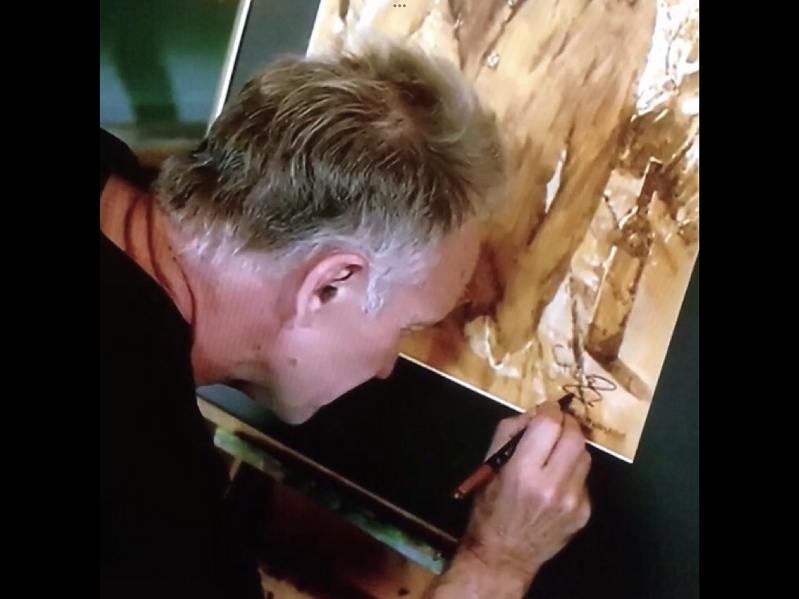
In the summer of 2018, I received a call asking whether I would participate in a television programme centred around an interview with Sting. Three artists were invited to create paintings, each representing a different episode from his life. These works would serve as the starting point for the interview and would later be auctioned for charity.
I was asked to create a portrait of Sting together with his wife Trudie Styler - in less than a week. An almost impossible task, especially considering that I was still recovering from a life-threatening situation (which I will elaborate on later in my book). My cardiologist was not amused by my decision to accept the commission. Too much stress and tension could have serious consequences. But I simply could not let this opportunity pass.
I did set a few conditions: I wanted Sting to be photographed with the painting, my name to be mentioned, and my website to be included. Visibility, after all, does not come easily.
The reference photograph was predetermined by his management. I had to portray Sting and Trudie in their garden in Tuscany, including a bottle of wine from their own vineyard. Sting owns the estate Il Palagio, where exceptional organic wines are produced. I can confirm this, as I received a case of his wines as a token of appreciation. The interview took place at Soestdijk Palace, where Sting would perform later that evening. The key figure behind this entire project was Matthieu Klaassen, a friend and importer of Sting’s wines. We are still in touch and continue to support each other in our respective work.
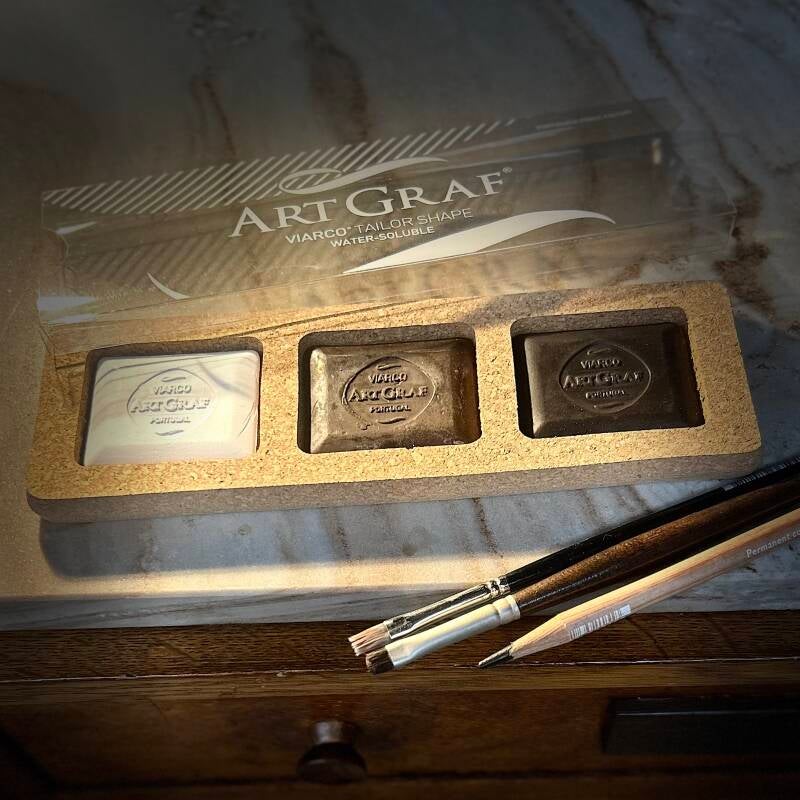
Working at great speed, I completed the painting and, for the first time, used the water-soluble pigment blocks of ArtGraf. It was the artist and materials specialist Paole Stokman who first introduced me to this material - as an alternative to gouache and watercolour, yet with a character entirely its own. What intrigued me immediately was her observation that these pigments carry a distinctly Mediterranean quality.
For this painting, I deliberately chose a palette that echoed the atmosphere of Tuscany. On a warm, ochre-toned ground, I worked with the ArtGraf Earth Tones set. It felt as though the material allowed me not only to depict the subject, but also to capture something of the spirit of the place itself.
Looking back, I realise how closely this aligns with the way Sting himself once described Il Palagio: “like stepping into a painting.” It is a remarkable thought - that the place I was trying to translate into paint had already been experienced by him in exactly those terms.
This moment marked the beginning of a new phase in my work. The story of this discovery, and everything that followed, will become an essential part of my upcoming book On the wings of my time.
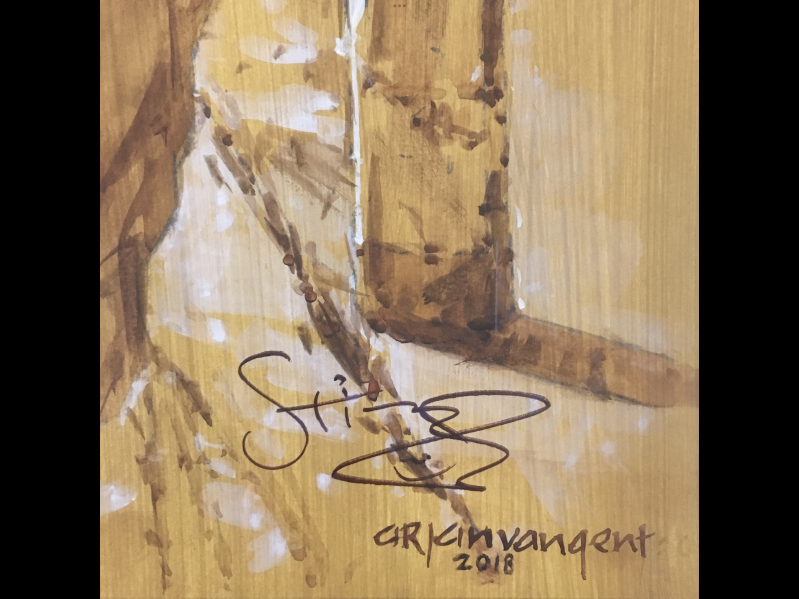
Despite the intense time pressure — and the disappointment that followed when my name was not mentioned on air - I remain proud to have contributed to this project. It is still a strange experience to hear Sting speak warmly about the painting, describing what Tuscany, his wife and his wines mean to him. The photographs of him signing my work for charity and standing beside it are, of course, invaluable.
I managed to complete the painting, and even created a small additional portrait for him. Unfortunately, there are no images of that moment, and who acquired the main work at auction remains unknown to me. Yet over time, that question has only become more intriguing. The way he responded to the painting, combined with the circumstances of the auction, leaves open a quiet possibility that the work may have found its way back to him - a thought that, whether true or not, gives the story an unexpected and fitting resonance.
It may be wishful thinking, but I still hope to meet Sting one day at one of the intimate acoustic concerts he hosts annually at his estate. On various YouTube videos, I have already spotted Matthieu attending these gatherings, so who knows. Italy has long been my favourite destination abroad, and I have spent many years giving painting workshops in that region - something I hope to continue in the future. It is a country overflowing with cultural richness, a place that feels like a warm bath and a second home.
What I could not have imagined at the time is that this very material would, years later, bring me into contact with the Portuguese family company Viarco, who continue to produce these remarkable pigments with care and craftsmanship. I have never been to Portugal, but if there is one place where material, tradition and artistry come together, I now know where I want to go - perhaps even to give workshops there in the future.
Add comment
Comments